Six Seats, One Kit Bag: Setting Up a Matchday Car-Share That Families Actually Trust
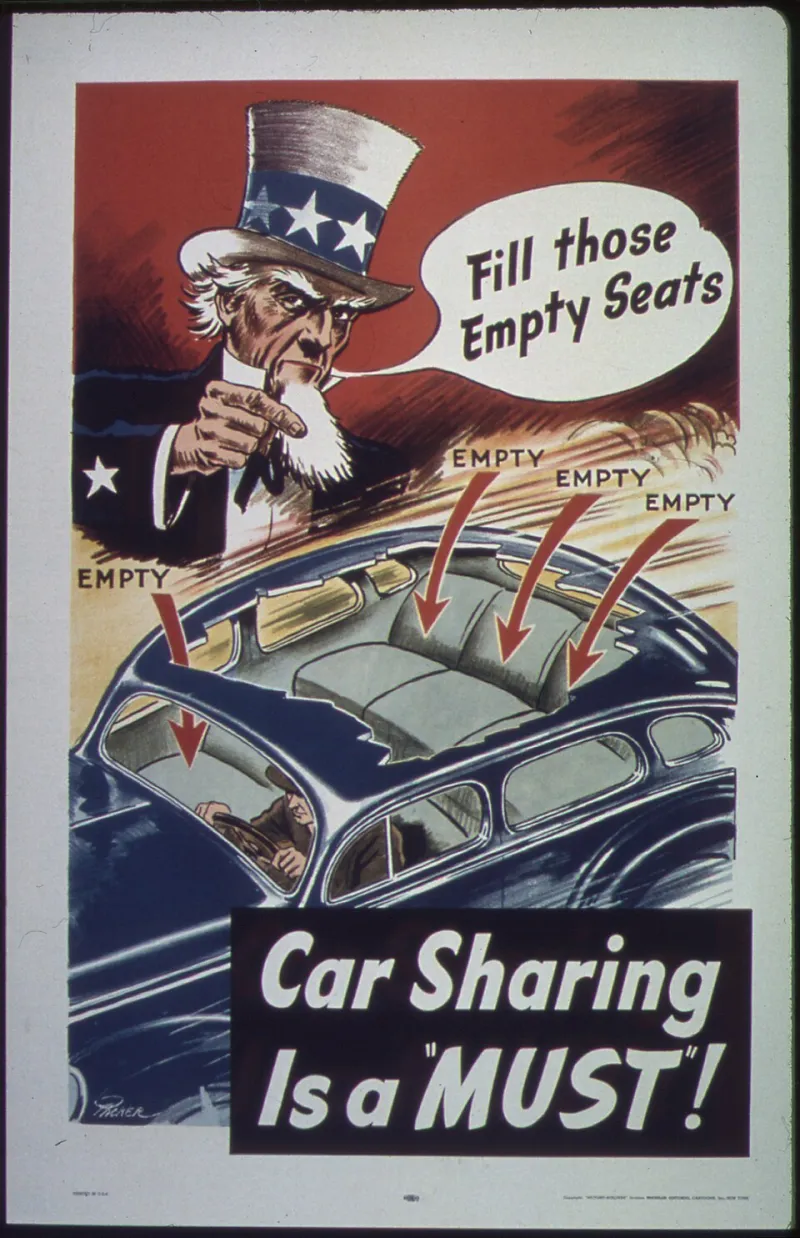
Photo: Packer, poster artist, Artist (NARA record: 8467744), Public domain, via Wikimedia Commons
Eight forty on a Saturday morning, and the group chat is doing what it always does. One parent is asking whether anyone is heading past Junction 9. Another posts a thumbs-up emoji, then quietly removes it twenty minutes later when the dog needs the vet. Meanwhile, three names on the team sheet live in villages where the bus runs twice a day and neither time is remotely useful.
We talk a lot about cost of kit and cost of subs, and rightly so. Transport is the barrier that hides in plain sight — a family with one car and two shift workers, a teenager fourteen miles from the pitch, a parent who would happily pay the match fee but cannot face a two-hour round trip on a Sunday. A minibus solves this if you are lucky enough to have one. A lift-pool solves it if you are not.
Start with the principle, not the spreadsheet
Before anyone builds a rota, agree two things in a committee meeting and write them down.
First: lifts are voluntary and they are never a condition of selection. No player should ever be left out because a driver fell through, and no driver should feel conscripted. Second: everybody who needs a lift gets treated the same way. The most common failure is not a lack of goodwill — it is three families quietly becoming a permanent taxi service for the whole squad while everyone else assumes it is sorted.
Say those two things out loud at the start of the season and half the politics disappears before it starts.
Consent, in language people understand
Every player under 18 travelling with another adult needs written permission from a parent or carer. Keep it short and specific: who is driving, who is travelling, the pick-up point, the drop-off point, an emergency contact, and a clear line stating which named adults the young person may travel with.
Where a child is old enough to have a view — and most secondary-age players do — ask them. A lift-pool that a 14-year-old is not comfortable with is not a lift-pool, it is a weekly ordeal. Give them an easy way to say no without it becoming a scene.
The 2026 habit worth adopting: fold a travel permissions block into your annual membership renewal. One page, once a year, refreshed with the contact details you are already collecting. No chasing in November.
Safeguarding sits on four wheels
This is the part clubs get nervous about, and the nerves are sensible. The rules are not complicated, but they need to be consistent.
As a working rule: two adults in the car, or three or more players. A single adult should not be alone in a vehicle with one unrelated child. If a journey genuinely cannot avoid that, tell the club welfare officer in advance, tell the parent, and log it.
Keep pick-ups and drop-offs visible. Car park, well lit, in front of other people — not round the back of the pavilion. Make it the norm so nobody has to make an awkward request.
On DBS checks: driving volunteers to matches is not, in itself, regulated activity. Many clubs still ask regular rota drivers to complete a check through the club, and that is a perfectly reasonable condition of being on the list. Put it in the policy, explain why, and treat it as standard rather than suspicion. An unexplained rule feels like an accusation; an explained one feels like care.
The insurance paragraph nobody reads until they need it
Club public liability does not cover private motor vehicles. Each driver needs their own cover, and each needs to confirm it.
A one-page annual declaration does the job: full UK licence held for at least two years (your club can set that bar), MOT in date, vehicle taxed, insurance in place for social, domestic and pleasure use, and confirmation that the insurer is aware of voluntary carriage if they require notification.
Give lifts without payment and you are usually on firm ground. The phrase to watch for is hire and reward — the moment money looks like a fare rather than a contribution, exclusions can bite. Keep the declaration on file with the date it was signed and a diary note to renew it twelve months later. It is fifteen minutes of admin once a year.
Fuel money without the awkwardness
Somebody will offer to chip in and somebody will refuse to accept. Both are fine. Take the sting out of it by agreeing a suggested voluntary contribution per journey or per mile at the start of the season, published openly, paid directly to the driver.
Make clear that it is optional, that it never buys priority, and that no club funds are being used to pay anybody for driving. A contribution towards petrol is a thank-you. A payment for a service is a different thing entirely, with different insurance implications.
The admin habits that keep it alive all season
- One named coordinator. Not a committee, not a rotating volunteer. One person with the spreadsheet and the phone number.
- A simple grid. Player, home area, seats needed, named drivers, seats available. Nothing fancier than that.
- Wednesday send, Friday confirm. Rota goes out with the fixture, confirmations come back by Friday evening, and a final reminder lands Saturday morning with the meet time and the postcode.
- A standby driver per fixture. Someone not on the rota who has agreed to be called at short notice. This one habit prevents most cancelled lifts.
- Addresses, not descriptions. Postcode, parking notes, which entrance. Not the usual place.
- Text on drop-off. Driver messages the coordinator or the parent. Thirty seconds, enormous peace of mind.
- Two reviews a year. October and February, ask the drivers what is broken and fix it before the spring.
Make saying yes feel worth it
Drivers are volunteers too. Reserve them a parking space, put a hot drink in their hand, and rotate the rota so the same three households are not carrying the entire season. If a coach can cadge a lift now and then, do it — nothing flattens a hierarchy faster than the person with the clipboard sitting in the back seat.
When it goes wrong, and it will
A driver goes down with flu on Friday night. A fixture is moved at short notice. A child decides at the last minute that they would rather not travel with that particular adult. Have a fallback: the coordinator calls the standby, the coach gets a message, and nobody is blamed. Log the near-misses so the pattern shows up before it becomes a problem.
Count it, then tell people
If the lift-pool keeps three extra players in each age group through the winter, that is three players who would otherwise have drifted. Write the number down. Mention it at the AGM. Transport is unglamorous, it does not photograph well, and it is one of the cheapest participation wins available to any club in the country. Six seats and a kit bag will do more for your retention figures than most of what gets discussed in the committee room.