Start at the Gate: The One-Hour Ground Audit Families Help Write
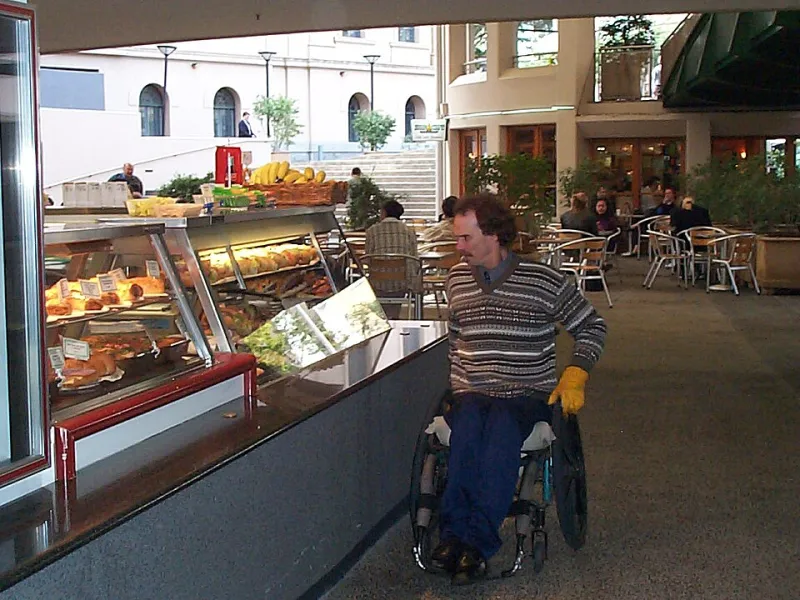
Photo: John Robert McPherson, CC0, via Wikimedia Commons
Accessibility is not a ramp. It is a hundred small moments that add up to either a welcome or a quiet decision to stay away. A club can have a perfectly good ramp and still lose a family at the car park, the gate, the sign that points to the wrong door, or the changing room that has become a store cupboard.
That is why the best accessibility walk-through is not a clipboard exercise done by one committee member on a wet Tuesday. It is an hour, walked with disabled players and families, from the moment they arrive to the moment they leave. The aim is not a gold standard. The aim is three honest fixes this month and a habit of looking again next season.
Start before the gate
Pick a normal training night rather than an empty ground. Empty grounds hide the real experience: the rush at the gate, the car park filling up, the queue at the tea hatch, the noise in the changing room. Invite two or three disabled members or families to walk with you. Ask them to be the guide, not the exhibit. Pay their travel if that is a barrier, and say thank you in a way that does not feel like a favour.
The route should follow the journey a visitor actually makes. Car park first. Then the approach, the gate, the welcome, the signs, the changing rooms, the toilets, the spectator area, the pitch edge and the tea hatch. One hour is enough if you keep moving and take photos as you go.
The route we use
At the car park, look for the Blue Badge bay. Is it close, clear and actually free of kit bags and goalposts? Is there a dropped kerb, or does the route finish with a lip that catches a wheel? Is the surface firm enough in winter? Is the walk to the entrance lit and easy to follow after dark?
At the gate, check the width and the weight. Can someone open it while using crutches, a wheelchair or a pushchair? Is there a bell, a phone number or a person nearby if they need help? Is the welcome point obvious, or does every new family have to guess which door is the right one?
Signs deserve their own look. Can you read them from a seated position? Is the contrast strong enough? Do they use plain words and arrows rather than club shorthand? An accessible toilet sign that is hidden behind a mop bucket is not really a sign. Neither is a changing-room label that says Under 12s when it is also the only quiet space on a Saturday morning.
Inside the changing rooms, look at benches, hooks, floor space and privacy. Is there room for a kit bag and a wheelchair without blocking the door? Can someone change with dignity? Are showers and cubicles usable, or are they storage for spare nets? You do not need a perfect pavilion to make a start. You do need to be honest about what is not working.
The toilets are often the quickest test of whether a club has thought about access. Is the accessible loo genuinely available, clean and unlocked? Are the grab rails secure? Is the alarm tested? Is there space to turn? If the answer is no, that is not a failure of the family. It is a job for the committee.
Spectator areas matter too. Can someone sit with a clear view without being in the way of the linesman or the pushchairs? Is there shelter from rain and wind? Are there spaces for wheelchairs that are not on a slope or behind a post? At the pitch edge, check gates, grass or 3G surface, benches and lighting. And at the tea hatch, check counter height, payment options, seating and whether someone can get a drink without leaving the pitch area.
Ask better questions
Do not ask, is it accessible? Most people will say yes because they do not want to make a fuss. Ask instead: where would you hesitate? What would make you turn round? Where would you sit at half-time? Could you get a drink without asking three people? What should we put on the website so the first visit is less of a guess?
Those questions give you a list you can act on. They also give you something more valuable than a tidy audit form: a relationship with the people who know where the ground really works and where it quietly does not.
Three fixes you can make this month
First, clear the first ten metres. Unblock the accessible bay, move the kit skips, trim the hedge, fix the light and put a clear sign at the entrance. This is often free and it changes the arrival more than any grand plan.
Second, publish a one-page arrival guide. Use photos of the car park, the gate, the reception point, the accessible loo and the quiet spot. Add a named contact and a phone number. Put it on the website and send it with the joining email. Families should not have to reverse-engineer your ground from a postcode.
Third, fix one room rather than the whole pavilion. Add a bench, lower a hook, clear a corner, put a chair in the changing room, move the bin out of the turning space. Small physical changes are easier to fund and easier to prove. Then write down what you cannot fix yet and put it in next season's budget.
Make the walk a habit
Repeat the hour every autumn and every spring. Add it to the welcome pack, the committee calendar and the AGM. Share what you found with members, including the things you have not solved. That honesty is part of the welcome.
ESCSA clubs do not need to be perfect venues. They need to be places where families can see themselves arriving, changing, playing, watching and staying for a cuppa. The walk-through is how you find out whether that is true, and what to do next.