Ten Minutes That Travel: A Warm-Up Both School and Club Can Use
It is 4:15pm on a Friday and the school hall smells faintly of floor polish. Benches are pushed back, the netball posts are wheeled into the corner, and thirty Year 5s are trying to remember whether they are doing sharks and fishes or tig. By 9am on Saturday, many of those same children will be on a club pitch, stamping their feet against the cold and wondering why the warm-up has suddenly changed.
That jump from hall to pitch is normal, but it does not have to feel like starting again. At ESCSA, we speak to plenty of teachers and coaches who have quietly built their own warm-up routines. The trouble is that the routines rarely match. One uses traffic lights, another uses cones and numbers, and a third just runs the children round the pitch until they are pink. None of it is wrong. It is just harder for children to carry one idea from Wednesday PE to Saturday fixtures.
A shared ten-minute warm-up changes that. It gives everyone the same language, the same shape and the same expectations, whether you are on a shiny hall floor or a muddy grass pitch.
Why one routine beats two
Children are brilliant at adapting, but they are even better when they know what is coming. A familiar warm-up lowers the background noise of a session: where do I stand, what do I do first, will I be embarrassed because I cannot remember the drill? For a child moving between school and club, that familiarity is a small confidence boost that lasts the whole session.
There is a safety side too. A progressive warm-up that raises the heart rate, takes joints through their range and includes some controlled landing, turning and change of direction is linked with fewer soft-tissue injuries in youth sport. It will not stop every knock or twist, and nobody should pretend otherwise. But a routine that is repeated consistently is more likely to be done properly than a different set of drills every week.
And let us be honest: a shared routine makes life easier for the adults. Teachers and coaches do not need to invent a new session starter every time. They just need the same cards, a bit of floor or grass, and ten minutes.
The four blocks: Wake Up, Loosen Up, Switch On, Go
Keep the frame simple and use the same words in school and at club. Four blocks, roughly two to three minutes each.
- Wake Up - raise the heart rate and get the blood moving. Walking, brisk marching, skipping, side-steps, small jogging games. No long queues, no elimination games, no standing still.
- Loosen Up - move the main joints through their range. Arm circles, leg swings, hip openers, gentle trunk rotations, ankle rocks. Keep it controlled rather than bouncy.
- Switch On - wake up the muscles that keep knees and ankles stable. Bodyweight squats, glute bridges, calf raises, single-leg balances, small hops and controlled landings.
- Go - a short, sharp finish that points towards the session. Two or three quick turns, a reaction game, a couple of 10-metre accelerations, or a ball-carrying relay. It should feel lively, not exhausting.
That is it. The same four words work in a hall, on a 3G pitch, on grass, or even on a playground. The activities change to suit the space, but the language stays the same.
In the hall: small space, big energy
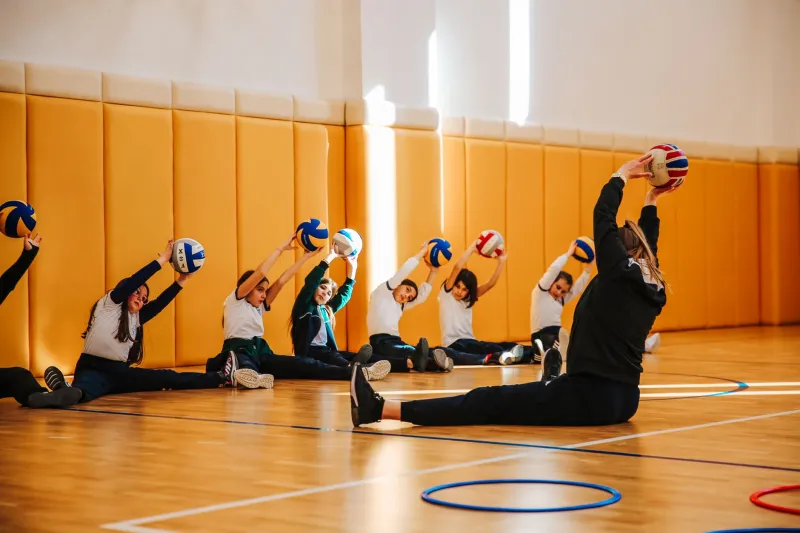
The hall is tight, so avoid long sprints and wide games. Use the lines on the floor, the benches and a few cones to create grids. Children can work in small groups or pairs, moving between stations on your signal.
A simple hall version might look like this: two minutes of walking and side-stepping around the grid, then leg swings and arm circles by the wall, then squats and single-leg balances on the floor, then a quick reaction game where children move to a cone colour. The whole thing fits into a netball court and needs almost no equipment.
Keep the volume manageable. Give instructions once, use a whistle or a clap to change blocks, and let children practise the routine until they can move between stations without a full demonstration. That repetition is the point.
On the pitch: cold hands, safe starts
The pitch asks for a longer Wake Up block, especially in winter. Children arrive in coats, stand around, and then launch into a sprint. That is the moment to slow down and build up. Start with brisk walking and skipping, add in some arm swings and leg swings, then move into squats, lunges and controlled landings before any fast running.
Use the space you have. A half-pitch is plenty. Set out four cones as a rectangle and keep the activities inside it. If you have balls, use them in the Go block: dribbling, turns, quick passes. If you do not, reaction games work just as well.
One practical note: check the surface. Frost, leaves and muddy patches change what is safe. A warm-up that works on a dry September pitch may need adapting in November. That is not a reason to abandon the routine. It is a reason to have a wet-weather version on the back of the card.
Progression cards that do the handover for you
A shared routine only works if the people delivering it can actually share it. Make a simple set of A5 cards, laminated if possible, with the four blocks on one side and three progression levels on the other.
Use plain language. Step 1 might be a walking side-step; Step 2 a faster side-step; Step 3 a side-step into a small acceleration. Teachers recognise this as differentiation. Coaches recognise it as scaling. Children just recognise it as the same move with a new challenge.
Add a small note for the hall version and the pitch version on each card. That way a PE lead can hand the set to a club coach, and a coach can send a photo to a teacher. No lengthy meetings required. The cards do the talking.
What parents and new players notice
Parents notice when a club feels organised. They also notice when their child is not stood in a queue for ten minutes. A shared warm-up cuts down on both. New players see other children doing something familiar, and they join in faster. Children who have done the routine at school arrive at club already knowing the words.
That matters most for the child who is trying club sport for the first time. They have enough to think about: new faces, new kit, new changing room. The warm-up should not be another unknown.
Five rules for making it stick
- Keep it to ten minutes. A warm-up is not a fitness test.
- Everyone moves, all the time. Avoid elimination games and long demonstrations.
- Use the same four block names in school and at club.
- Adapt for the space, not the language. Hall and pitch versions should sound the same.
- Review it after three weeks. Ask the children what they remember, then tweak the cards rather than starting over.
Try it this week
Pick four activities, one for each block, and write them on a card. Try them in the hall on Wednesday and on the pitch at the weekend. Change the space, keep the words. If you are a teacher, send the card to your local club. If you are a coach, ask your partner school what they already use.
Ten minutes is not a lot of time. But when it is the same ten minutes in both places, it can make the whole week feel more joined up.